
Buying a towable rock crusher can give a contractor more control over broken concrete, rock, and other suitable material generated during demolition and construction work. Instead of hauling every load away and purchasing aggregate for the next stage, the material can potentially be processed close to where it is needed. Once different crusher options are compared, however, production capacity is only one part of the decision. Feed opening, transport weight, power system, discharge setup, and service access all affect how well a machine fits the work.
Machine size and configuration can have a direct impact on daily usability. The feed opening needs to suit the material being processed, while the power system must provide enough performance for the expected workload and ground conditions. Transport weight and overall dimensions also matter when the crusher needs to move between projects, and the discharge setup can influence how easily processed material is handled or stockpiled.
Long-term value depends on how well the crusher matches the contractor's actual jobs. A machine that suits the material, production needs, transport requirements, and service routine can remain useful across multiple projects rather than becoming equipment that is difficult to move or operate efficiently. Looking at the complete machine configuration gives contractors a clearer basis for selecting a towable crusher that fits their workload and jobsite demands.
Crushing Capacity for Project Demand
Capacity tells you how much material a crusher can process over a given period, and it's the natural first number most buyers look at. The right way to read it, though, is against your own work. Consider how much material your typical projects generate and how quickly you need it processed, then match a machine to that reality rather than to the largest figure on the spec sheet.
A crusher sized to your actual workload keeps a practical crushing cycle running without stalling or sitting idle. Buy too little capacity, and the machine becomes a bottleneck on busy jobs. Buy far more than you need, and you carry the cost and bulk of capacity that rarely gets used. The goal is a dependable match between what your projects produce and what the machine can handle day in and day out.
Key takeaway: Capacity should match the material your typical projects generate and how fast you need it processed, not simply the highest figure available.
Feed Opening and Material Size
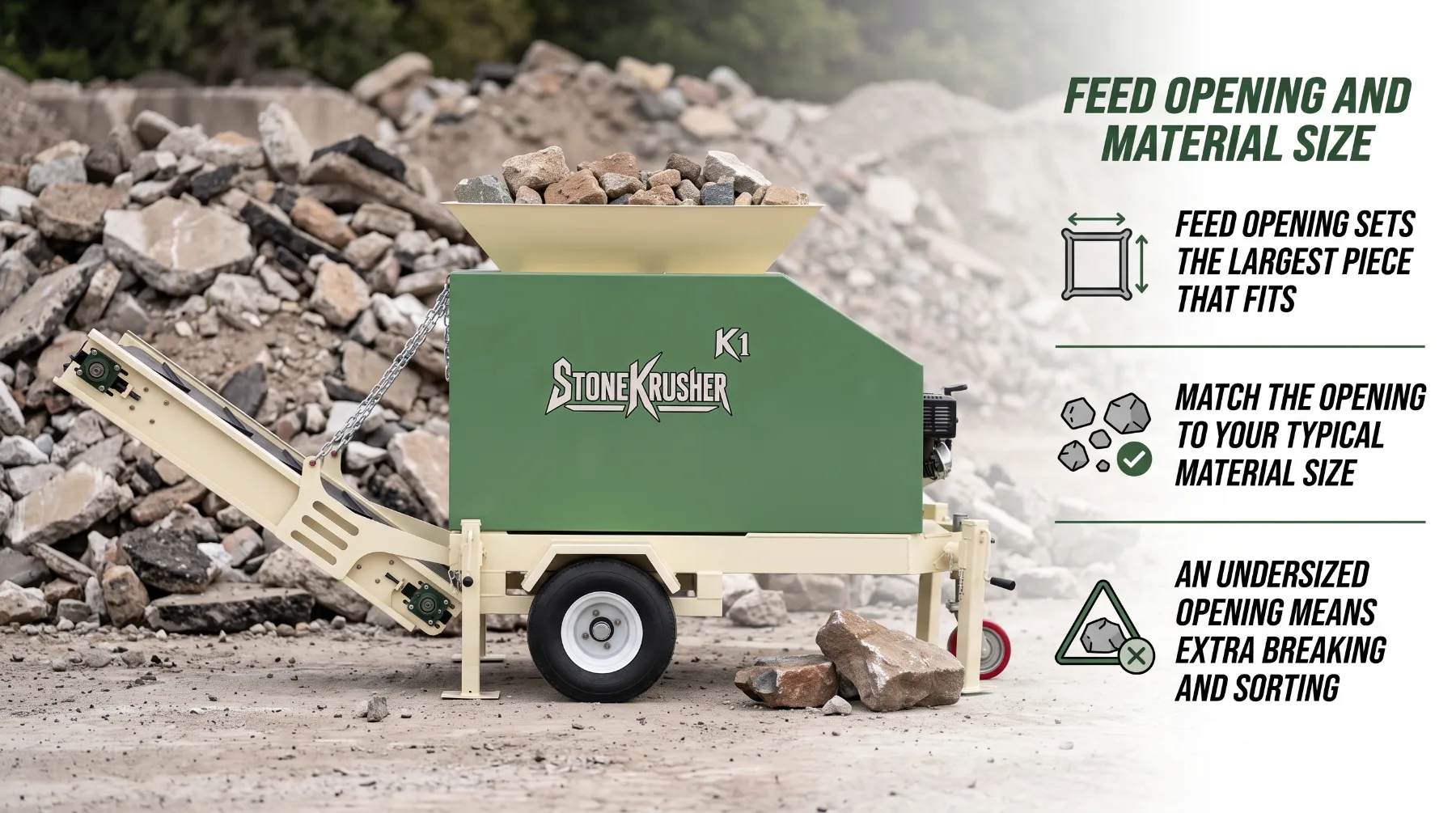
The feed opening determines the largest piece of material that can enter the crushing chamber, which makes it one of the most decisive specifications for real-world use. A capacity figure means little if the material you're feeding won't fit through the opening in the first place.
Weigh the feed opening against the material you actually expect on your jobsites. The type and size of rock, concrete, or other suitable material arriving at the crusher should sit comfortably within what the opening can accept. If your demolition work regularly produces large concrete pieces, an opening sized for smaller feed will slow you down with constant breaking and sorting before material even reaches the machine. Understanding your incoming material size up front is what tells you whether a crusher's configuration genuinely suits the application.
Key takeaway: The feed opening sets the maximum material size the crusher can accept, so match it to the rock or concrete size your jobsites actually produce.
Transport and Towable Design
The towable frame is the whole point of this class of machine, so it deserves close attention when the crusher will move between multiple projects. Overall dimensions, connection points, tires, support components, and transport weight all affect how practical relocation will be, and all should be reviewed before purchase rather than discovered on the first move.
The towing setup matters just as much as the crusher itself. Your towing vehicle and hitch arrangement must be suitable for the machine's weight and configuration, and the whole setup has to comply with applicable transportation requirements for the areas you work in. A crusher that's easy to process material with but difficult or non-compliant to tow undercuts the mobility you bought it for. Confirming that the transport design fits your vehicles, your routes, and the regulations you operate under keeps relocation a routine part of the work.
Key takeaway: For a machine that relocates often, review dimensions, connection points, tires, support components, and transport weight, and confirm the towing setup is suitable and compliant.
Power Source and Operating Requirements
The engine or other power system supplies the energy for crushing and the machine's related functions, and there's more to evaluate here than horsepower alone. Fuel requirements, operating conditions, maintenance access, and the service support available for the power system all factor into how the machine performs and what it costs to run over time.
The sounder approach is to judge the power system against your expected workload rather than a single rating. A power system suited to the demands of your typical crushing keeps the machine working reliably, while one chosen on horsepower alone may prove ill-matched to real operating conditions or awkward to service and support. Consider how and where you'll run the machine, what fuel and servicing it requires, and whether support is available when you need it. Matching the power system to the actual work protects both uptime and long-term operating cost.
Key takeaway: Evaluate the power system by fuel needs, operating conditions, maintenance access, and service support against your workload, not by horsepower alone.
Conveyor and Material Discharge
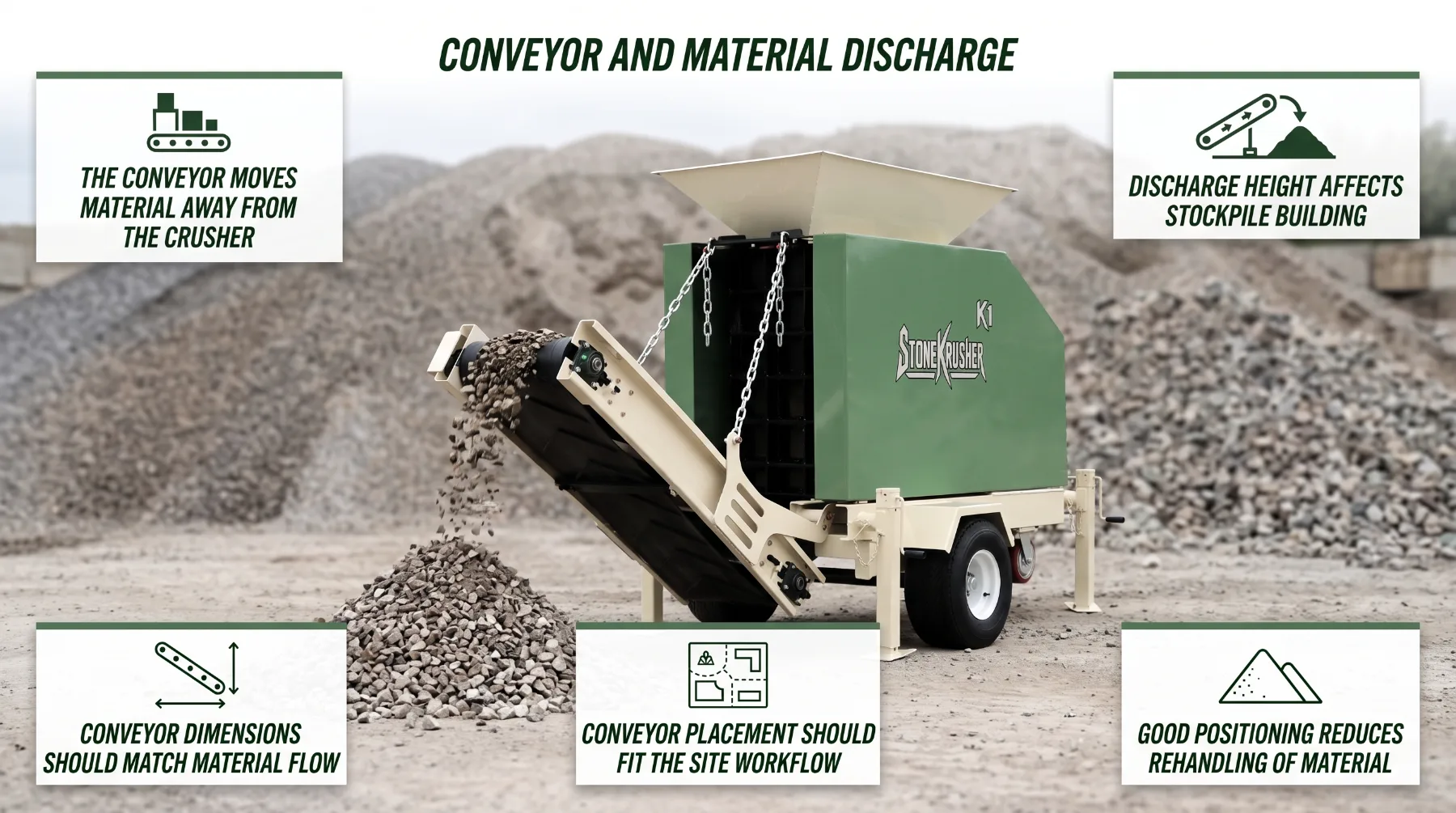
After material passes through the crusher, it needs to be moved away from the discharge point efficiently. A conveyor transfers processed material into a stockpile or another handling area, helping maintain a continuous crushing cycle without material building up around the machine.
The conveyor setup should match the site's workflow and material-handling needs. Conveyor dimensions, discharge height, and positioning affect stockpile size, rehandling requirements, and how well the crusher works with other equipment on site.
- Material Transfer: Moves processed material away from the crusher discharge point.
- Discharge Height: Determines how effectively material can be placed into a stockpile or handling area.
- Conveyor Dimensions: Should suit the required material flow and overall machine layout.
- Stockpile Management: Proper discharge positioning can help build larger, cleaner stockpiles and reduce rehandling.
- Site Integration: Conveyor placement should fit the available space and connect smoothly with the site's material-handling workflow.
Key takeaway: The conveyor moves processed material into a stockpile, so consider its dimensions, discharge height, and layout against your intended workflow.
Machine Stability at the Jobsite
Before any crushing begins, the machine needs a stable working position, and how easily it reaches that position varies from machine to machine. Stabilizing legs, support points, and the frame design all affect how straightforward the crusher is to position and prepare for operation once it arrives on-site.
That transition from transport to a stable working setup is worth examining before you buy. A machine with well-designed stabilizing components settles into a solid, level working position with less effort at each new site, which matters when relocation is frequent. The crusher must also be placed on suitable ground according to the manufacturer's requirements, so a design that's simple and predictable to set up saves time on every move. Considering stability and setup up front helps you choose a machine that's ready to work soon after it arrives.
Key takeaway: Stabilizing legs, support points, and frame design determine how easily the crusher reaches a stable working position, and it must sit on suitable ground per the manufacturer.
Maintenance and Service Access
Owning crushing equipment means committing to regular inspection and maintenance, so how easily you can reach the parts that need attention deserves real weight in the buying decision. Access to the engine, hydraulic components, the crushing mechanism, the conveyor, and other service points shapes how much of a chore routine upkeep becomes.
Straightforward service access pays off every time the machine needs attention. When the key components are reachable without a struggle, routine inspection and servicing get done properly and on time, which supports reliability and helps the machine hold up over its working life. A crusher with awkward or cramped access invites skipped checks and longer downtime whenever a repair is needed. Looking closely at maintenance access before purchase is a practical way to protect both uptime and the long-term value of the machine.
Key takeaway: Regular maintenance is part of ownership, so consider how easily you can access the engine, hydraulics, crushing mechanism, and conveyor before you buy.
Conclusion
Buying a towable rock crusher requires evaluating the complete machine against the material, production requirements, jobsite conditions, and transport needs rather than relying on a single specification. Crushing capacity should match the required processing volume, while the feed opening must accommodate the size of rock or concrete typically generated at the jobsite. The power system should provide suitable input for the crushing mechanism and operating conditions, with fuel type, service support, and duty cycle considered alongside rated power. Transport design also matters, including overall dimensions, transport weight, towing connections, tires, and compatibility with the intended towing equipment and applicable requirements. Conveyor dimensions and discharge height should fit the stockpiling or material-handling workflow, while frame design and stabilizing components must provide a suitable working base after transport. Maintenance access to the engine, hydraulic system, crushing mechanism, conveyor, and other service points should also be practical for routine inspection and upkeep. Evaluating these factors together helps identify a towable crusher that can process the required material, relocate efficiently, and remain practical to operate and maintain across multiple projects.
Frequently Asked Questions
What should I consider first when buying a towable rock crusher?
Start with your typical work rather than the machine's specifications. Define the material you process, the volume your projects generate, required capacity, transport needs, and available jobsite space. Material size and workload provide a useful benchmark for comparing crushers, while machine dimensions, weight, and towing setup matter if you move between projects. Consider how the crusher and conveyor will fit on-site as well. The right machine is one whose capacity, feed opening, transport design, and layout match your actual work conditions.
Why is the feed opening important?
The feed opening determines the largest material size that can enter the crusher. If incoming rock or concrete is too large, it must be broken down first, adding labor, time, and handling. A crusher may have high capacity, but that capacity is difficult to achieve if the material does not fit through the opening. Match the feed opening to the material your excavation or demolition work regularly produces to keep the crushing process efficient.
What makes a rock crusher suitable for frequent relocation?
A crusher suited to frequent relocation should have a transport-ready frame, practical dimensions, secure towing connections, and stabilizing components for setup. Overall width, length, height, and weight affect how easily it can be moved and positioned, while the towing system must match the vehicle and applicable transport requirements. Stabilizers provide a secure working base after arrival. Together, these features make repeated movement between suitable jobsites more practical.
Does conveyor design matter?
Yes. The conveyor controls how processed material leaves the crusher and enters a stockpile or handling area. Conveyor dimensions and discharge height affect stockpile size, material flow, and how much rehandling is needed. The overall layout also determines how well the crusher fits within the jobsite and works alongside other equipment. Matching the conveyor to your material-handling workflow can help prevent discharge backups and keep crushing cycles moving.
COMMENTS (0)
LEAVE A REPLY